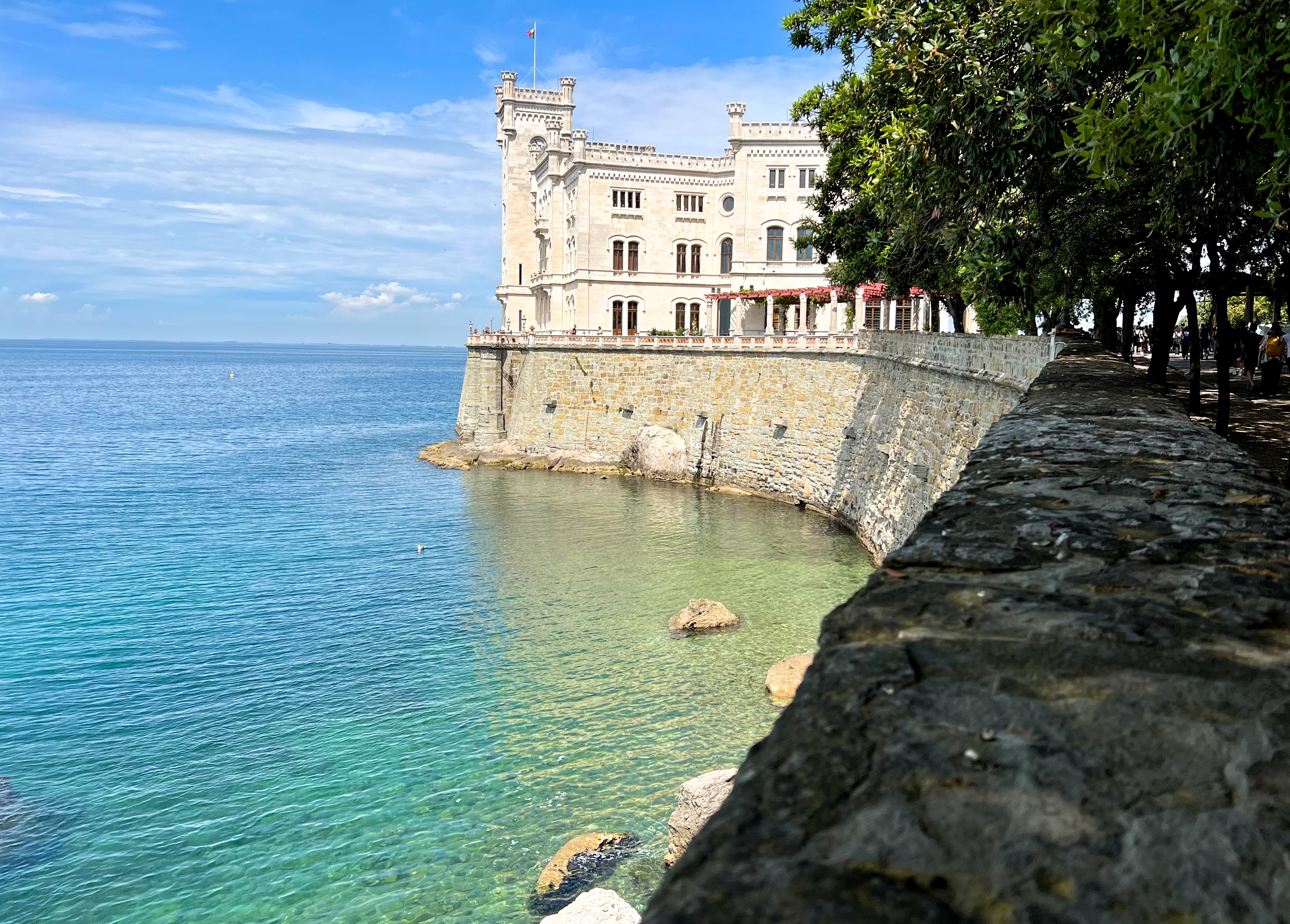
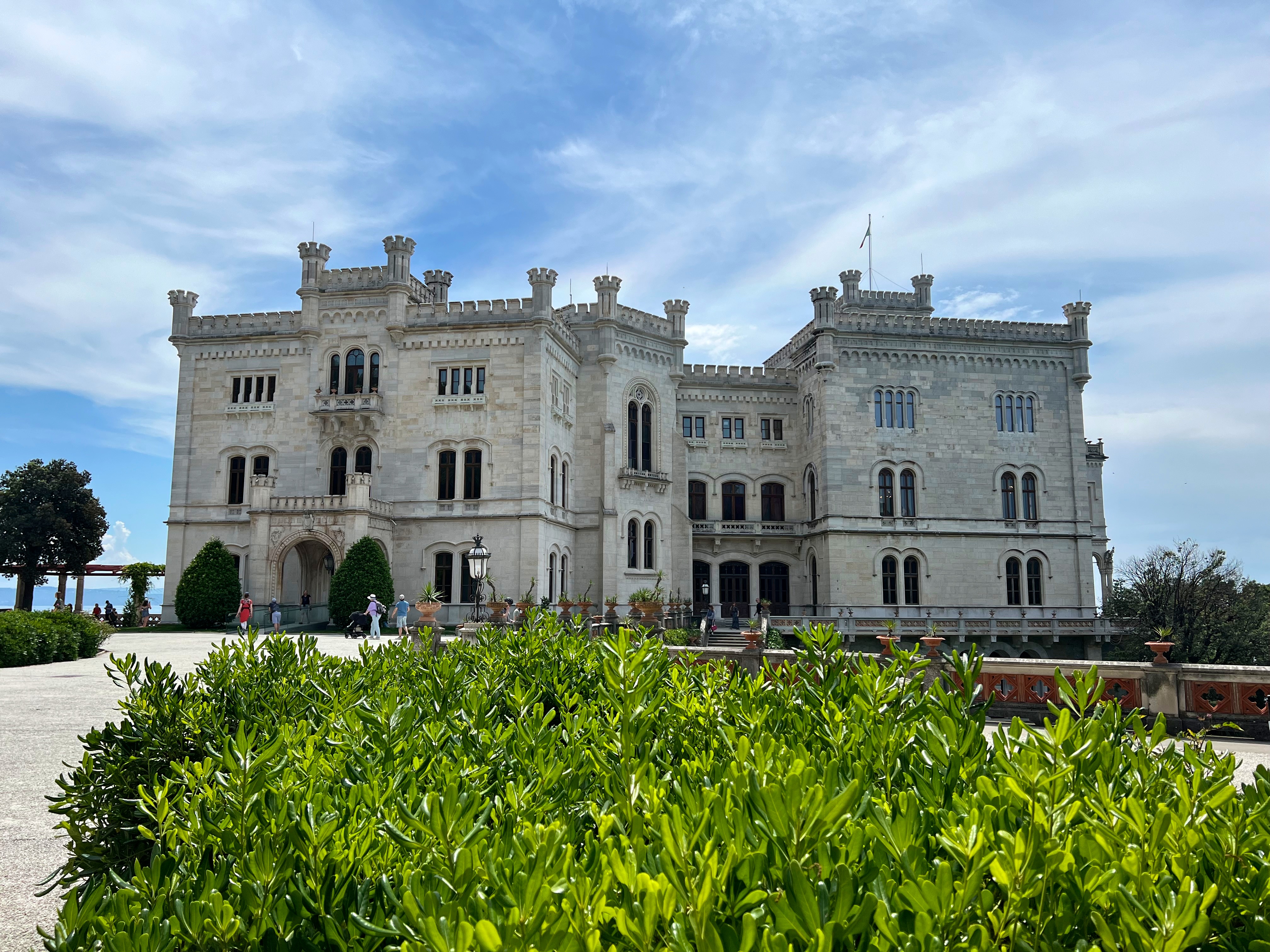
Taking advantage of the good weather, we flexed the itinerary and decided to visit the "Victory" lighthouse, the Faro della Vittoria, and the Castello Miramare north of the city.
We hopped on a local bus, traveled down the Strada del Friuli and got off at the entrance to the lighthosue. It was built at the end of the First World War to support local navigation, but also as a memorial to fallen seamen.

The lighthouse rises from the foundation of an old Austrian fort. The property is still considered military and is only open sporadically. It was our bad luck that it was closed when we were there so we couldn't walk around the grounds. Undeterred, I endeavored to circumnavigate the lighthouse to get the perfect photo.
I ascended the narrow Scala Eugenio Geiringer, more of a pedestrian lane than a road, past small residences and garden lots and arousing the attention of barking dogs. The peak of the lighthouse is decorated with the statue of the Winged Victory, by Giocani Mayer and Giacomo Sebroth.From the Via Lodvico Braidotti, I could also see the town of Barcola stretch out to the north and the peninsula, jutting into the Gulf of the Trieste, where we would later visit the Castello Miramare. The Winged Victory and lighthouse, beaming out across the Gulf of Trieste... Completing, by circumnavigation, here the Winged Victory is seen from below, st against a tumultuous backdrop of clouds ...To get back on the bus route, we decided to hoof it down the hill into Barcola, and that meant we had to cross the riliroad tracks. In this case, it meant going under the tracks through this tunnel.I noticed the red and white blaze on the right, but am not sure what trail it was a part of.
We jumped back on the bus and traveled down the Via le Miramare to the appropriate stop and then descended down the concrete path to the seaside promenade leading to the castle.
We saw signage and learned that Miramare is not only a historical and cultural center, but also the home to the first Italian maritime reserve, managed by the World Wildlife Fund since the 1970s.
The area is known for its high biodiversity of plants and animals, and it protects several threatened and endangered species . Of course, as a marine biologist, I wanted to go down to the water's edge and check it out, but otherwise, it was off limits. We did see some school children on the beach with a guide. Lucky them!
As we entered through the arched gate and continued up the tree-lined promenade...... more and more of the castle revealed itself.
The Miramare Castle and its park were built by order of the archduke, Ferdinand Maximilian, in 1865, back when this area was still under the control of Austria.
The castle's decor reflects Maximilian's wanderlust and various obsessions of the imperial age: a bedroom modeled like a frigate's cabin, ornate orientalist salons and a red silk-lined throne room. All the rooms feature the original furnishings, ornaments, furniture and objects dating back to the middle of the 19th century.
In his wife Charlotte's bedroom, a private place to pray.In an adjoining room, their private chapel with figures of the 12 apostles on the back wall. it was a more formal place to have a private mass.Maximilian, as Commander of the Navy, circumnavigated the world between 1857 and 1859.
I old love maps, and was taken by this painting in one of the main salons, perhaps completed as a tribute to his circumnavigation or his wanderlust. The construction of the castle was finished after Maximilian's departure for Mexico in 1864, where, after a brief reign as Emperor, he was executed in June 1867. So it would seem, he never got to enjoy it. Taking the steps down towards the horse stables provides a magnificent view of his protected harbor and the Gulf of Trieste beyond.
Before 1856, the castello park area was bare, with only some shrubs and thorny bushes covering the rocky promontory. But Maximilian was a keen botanist, and under the supervision of Carl Junker, the grounds now boast over 54 acres of landscaped gardens, bursting with the color and scents of rare and exotic herbaceous plants, shrubs and trees.
Within a period of ten years, cedars from Lebenon, North Aftica and the Himalayas were planted, along with firs and spruces from Spain, cypresses from California and Mexico, various species of pine from Asia and America. Exotic specimens, such as the giant sequoia and ginko bilboa were added. Miramare was conceived as a private garden of wonders, not intended for public use. Watercourses, pools, twisting paths, trees placed according to natural models, some grassy areas, are all typical of English gardens.
With our backs to the Adriatic, these steps ascended to a series of manicured terraces, fountains and...
... a large formal garden.
Kathi and I had a lovely lunch at the Massimiliano Cafe, overlooking the gardens.After a relaxing meal, I continued to explore the property, finding the "old" greenhouses used to cultivate the garden's rare plants and house and protect those exotic species that could not survive the winter.
Closer to the Adriatic, lies the Castelletto di Miramare . During the construction of Miramare Castle, the archduke had a small castle called the Gartenhaus or Castelletto built which reproduced, on a smaller scale, the façade of the main castle.
Some garden house!The view of Grignano from the garden house.
A playful, but inoperable, fountain outside the Castellietto...Between the old greenhouses and the chapel of San Canciano is the "Trout Fountain". It features a young boy with a heron, recalling the famous 2nd century Hellenistic sculpture of Eros strangling a goose.I loved this fountain, built into one of the garden walls. I want to make one at my house!Also nearby were the "new" greenhouses. The glass buildings are used to cultivate orange trees, a tribute to Maximillian's passion for citrus fruits.Circling back to the main castle terrace, these beautifully arbored steps lead up to the Lago dei Loti (Lotus Lake). On the lawn areas adjacent to the "lake", we remained on a bench contemplating our next move.
Among the trees, we ambled down the winding paths......and made our way back to the castle.It was well worth the effort to use the local bus transport to explore both the lighthouse and the castle; I'm so glad we did. We got a glimpse into the charmed life of Austrian royalty and learned about this land and its culture before and after it was unified with Italy after WWI.
We reluctantly left the beautiful gardens and grounds, walked under the shade of the entrance road, took a few last looks at the maritime reserve, climbed back up to Via le Miramare, made our way back to the bus stop, and chugged back to Trieste . 
In 1835, Revoltella founded a company for the import of wood and grains and quickly became a successful businessman. Through his trade he became a strong proponent and committed to the opening of the Suez Canal which he considered crucial for the economic development of Trieste and its maritime commerce. He was later appointed vice-president of the Universal Company of the Suez Canal, which financed and executed the cutting of the Isthmus. The museum was founded in 1872 after the baron left his house to the city.
At the base of one of the staircases is the group of the nymph Aurisina. To understand this fountain, a little history....
Encapsulated between the arid Karst (limestone cliffs) and the Adriatic Sea, Trieste has traditionally suffered from a lack of fresh water that has slowed and distorted its economic and demographic development. In 1859, the construction of the Aurisina aqueduct strengthened the growing city.
So in this fountain, the robbed female figure with her head adorned with a mural crown represents the city of Trieste, located on the seashore. Somewhat hidden in the back, are symbols of navigation and trade. She is in the act of summoning the nymph of the Aurisina spring from the caves of the Carso, inviting her to come down to her. The bat-winged genie of Darkness and the torch illuminate the path of the Nymph, who presents herself by lifting the veil that had kept her hidden from men for so many centuries. In the foreground of the group, two children, one representing the seafaring class and the other a worker, hurry to quench their thirst at the fresh waters that flow at the feet of the Nymph and descend into an enormous shell, symbol of the Adriatic.
Upstairs, we were treated to the main attraction - Van Gogh! We've been able to get up close to his works on these lat two visits to Italy, this time with more and diverse works that were astonishing.
"The Sower" is one of Vincent van Gogh's many evocative paintings, created in 1888, during his time in Arles, France. This work reflects Van Gogh's fascination with rural life and his admiration for the cycle of growth and renewal.
The drawing below, Carpenter's Yard with Laundry (1882), shows the view from Van Gogh's studio window on the first floor of his house in The Hague. From a panoramic bird's eye view, the laundry and carpenter's workshop behind it are rendered in detail. Women hang the washing out to dry and carpenters are working is the yard. A blossoming tree stands in a border in the foreground on the left.Van Gogh's drawings are special due to the fact that his depiction of figures, light, and landscape can be admired without the need for color. He drew using pencil, black chalk, red chalk, blue chalk, reed pen and charcoal, although he often mixed mediums when drawing. He drew on a variety of paper types and used any material available to him.
Although badly damaged, here, in Sorrowful Old Man (1882), he uses pencil, pen and brush in ink, opaque watercolor and traces of squaring on woven paper.
Old Fisherman Seated (1883)Here, the drawing that was the predecessor to his painting "Potato Eaters". The composition depicts the harsh reality of country life. His peasants have coarse faces and working hands; he wanted to show that they "have tilled the earth themselves with these hands they are putting in the dish....that they have thus honestly earned their food." Van Gogh's subsequent painting drew considerable criticism because its colors were so dark and the figures were full of mistakes. However, these days, Potato Eaters is one of Van Gogh's most famous works.
The exhibit also included a mini immersive experience similar to what we had gone to in Virginia Beach.The immersive videos surrounded us with 3-D versions of some of his most famous paintings, moving and shifting from one to another - everything in motion. Wonderous! In addition to the ink drawings, we were also treated to some of his other colorful works. In late February 1886, Van Gogh arrived in Paris and moved in with his brother Theo. Their small apartment lies at the foot of the 'butte' Montmartre on the northern edge of the city. At that time, this hill is still almost without buildings and has a rural character.
After his heated argument with Paul Gauguin, Van Gogh cuts off his own left ear. After his discharge from the hospital in Arles, Van Gogh tells his brother Theo that he intends to start working on two still lives the following day, to 'get used to painting again'. One of these is Still life with a plate of onions. The objects in the painting indicate that Van Gogh has picked up on the routine of everyday life again: the letter from Theo, the plate of onions, the pipe with tobacco, the bottle of wine or absinth, the pot of coffee, the calendar with the burning candle, the stick of sealing wax, the box of matches and finally, the book Annuaire de la santé about good nutrition and hygiene.
Words to live by...
The Garden of the Asylum of Saint-Remy (1889)One of my favorites, Landscape with Wheat Sheaves and Rising Moon (1889) ArlesIn these paintings, Van Gogh demonstrates his theory of the harmonies of juxtaposition.
Wheatfield in a Mountainous Landscape (1889) ArlesIn Arles, Van Gogh developed this scheme, using juxtaposed hues (on the color wheel) to create effects of colored light contrasting with the surroundings.
Wheat Stacks Under a Cloudy Sky (1890)The painting below, The Gardener (1889), is considered the most important Van Gogh in Italian public collections. It is a masterpiece of Van Gogh's Provençal period and shows some of the fundamental themes of his painting, such as the use of the portrait, the relationship with nature and the combination of primary and complementary colors. Whoa! Kathi and I were blown away by this exhibit. We were on the fence about squeezing it in to our itinerary but we were soooooooo glad we did. Just a reminder to never pass up these local shows and the opportunity to see master works in an intimate setting. It's also great to support local art installations so these major works can continue to be made public!
Kathi wanted to see the Castle of San Giusto, so we headed north, back in that direction. It was past 5 pm, and we were racing to get in before they closed by were drawn like a magnet to this window display of cheese. The castle was constructed between 1468 and 1636.
Crossing the drawbridge into the circular Venetian Bastion, there are several round stones - perhaps used with a catapult of some kind?
In the vestibule are two large 19th century bell-striking statues, taken from the town hall clock in the Piazza dell'Unita d'Italia.
The walls of the vestibule were decorated with local stone coats of arms belonging to noble families of Trieste from the 16th to 19th centuries. These families gathered their wealth from trade from saltworks, agriculture, vineyards, farming. Most of them boasted a descent from Roman families and united in the Confraternita delle Tredici Casade (Fraternity of the 13 Houses). The plaque below is dedicated to this fraternity.
Because it was late, some of the museum components of the castle were closed, but we could still walk the grounds. The castle was used as a residence for Austrian Imperial Captains until 1750 when it was converted for the use as a garrison and prison.
The extensive Soldier's Courtyard is enclosed by the fortress walls, with sentry walkways on the parapets.
Climbing the steps to the sentry walkways...
... we were greeted with splendid panoramic views of Trieste...
... and the Gulf of Trieste, even as the storm clouds gathered.What a sentry would see, looking down on the city...Flowering vines growing among the stone walls...Breaking through the storm clouds, a beam of light shines down on the Cathedral of San Giusto Martire.It was after 7 pm and we had missed an aperitif, but decided to head to Bar Hortice for a drink, a cool looking hangout I had seen on previous explorations. Unfortunately, it was closed (?) so we selected another spot on the same street with inviting outside seating, a little wine bar, Sapori Eccellente del Territorio (Excellent Flavors of the Territory), or SET. We turned in early because we were tired and tomorrow we would be venturing into Slovenia!


 Walking south on the Via Roma, we kept an eye out for on-street dinner options.
 At the Piazza della Borsa, there was this sign for the "Free Territory of Trieste".


 For a period of seven years, Trieste acted as a free city, but the territory was de facto dissolved in 1954 and Zone A was given to Italy and Zone B was given to Yugoslavia. This created a border dispute which was only settled twenty years later with the signing of the bilateral Treaty of Osimo in 1975 (ratified in 1977).


 Coming back down, you can see evidence of some of the Roman pieces (columns, tiles, etc.) incorporated into the structure.

 Just outside, monuments to "Theotokos"
 Next to the cathedral, were vestiges of the 1st century, ancient Roman forum.


 I did not go in, thinking that I would likely return with Kathi. Adjacent to the ancient Roman forum, and at the end of the Parco della Rimembranza, is the Monumento ai Caduti di Trieste a memorial to those who died in the First World War.


 We were pretty indecisive about where to eat, fatigue finally planting us at a table at Njoy, on the Via San Nicolo. Kathi had linguine with tomato ragu, pine nuts, basil and buffalo stracciatella and I had a surprisingly extra delicious potato gnocchi with beef goulash!